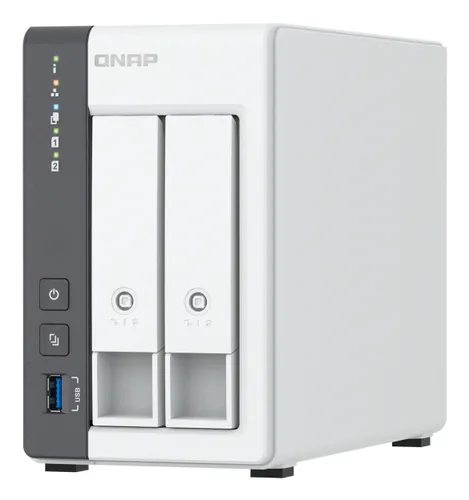
NAS drives QNAP
QNAP TS-216G NAS/storage server Tower Cortex-A Cortex-A55 4 GB 0 TB White
Relevance for this use: 55/100
When you deploy a NAS drive to run virtual machines or application containers, technical requirements far exceed those of simple file storage. Processing power, memory and network bandwidth become determining factors to guarantee the fluidity of several simultaneous environments. These intensive workloads demand components capable of sustaining complex operations without slowdown or interruption.
In this professional context, price becomes secondary facing the necessity to ensure service continuity and responsiveness of hosted systems. High hardware specifications avoid bottlenecks and allow infrastructure to evolve at the pace of projects. A drive suited to virtualisation thus distinguishes itself by its parallel processing capabilities and its multiple network communication paths.
The same criteria as on the category page, but not the same weight: here is what goes up and what goes down.
Budget takes second place when dealing with critical infrastructures that support essential services. Investments in high-performance components justify themselves through reduced downtime and increased productivity. An undersized server would generate indirect costs far exceeding initial savings, compromising the viability of hosted projects.
Processor power becomes the central pillar to manage several active virtual machines. The sixteen cores of premium range allow dedicated resource allocation to each environment without excessive sharing, guaranteeing constant response times even under high load. The two entry-level cores prove totally unsuited to this type of use that permanently mobilises multiple execution threads.
Memory constitutes the most solicited resource in virtualisation, each guest system claiming its own allocation. The one hundred and twenty-eight gigabytes of most equipped models offer comfortable margin to make numerous environments coexist without resorting to swap, a major source of performance degradation. Conversely, four gigabytes barely suffice for a single lightweight virtual machine and block any evolution.
The number of drive bays retains its importance to accommodate disk images of multiple virtual machines and organise redundancy. With eight median slots, you distribute loads across several volumes whilst maintaining high-performance RAID configurations. This expansion capacity remains useful without reaching the critical level of other components for this use case.
Multiple network ports become strategic to isolate management, production and backup flows without creating congestion. The six ports of premium servers allow connection aggregation to multiply available bandwidth or segment virtual networks. A single port creates a fatal bottleneck when several machines simultaneously exchange voluminous data.
The features pushed in this category that make no difference in this context.
Entry-level pricing
Seeking maximum economy on a virtualisation server leads to technical compromises incompatible with intensive loads. Budget models lack essential components to sustain several active environments and require rapid replacement. Higher initial investment amortises quickly through the stability and scalability offered.
Two-bay configurations
Servers limited to two storage slots severely restrict redundancy options and volume distribution. For virtualisation where each system requires its own space, this limitation forces difficult choices between performance, security and capacity. More extensible models avoid these constraining arbitrations.
Orders of magnitude, not displayed prices: a price only appears on Kalyneo once it has been collected from a merchant, with its collection date.
Under €200
Models under two hundred euros lack processor and memory resources to efficiently manage the slightest virtual machine in real conditions.
€200 to €500
Between two hundred and five hundred euros, certain servers offer acceptable bases but quickly reach their limits with several simultaneous environments.
Over €500
Beyond five hundred euros, configurations combine multicore processors, abundant memory and multiple network connectivity for demanding virtualisation.
Ranked by relevance for this specific case, not by their overall score.
NAS drives QNAP
Relevance for this use: 55/100
A product only enters this list if it meets every one of these points. Its relevance is rated for this specific use, independently of its overall score in the category.