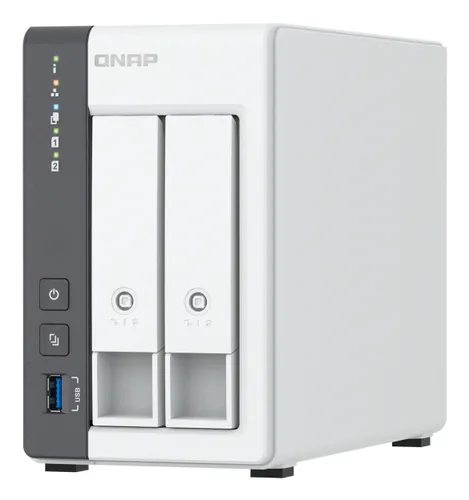
NAS drives QNAP
QNAP TS-216G NAS/storage server Tower Cortex-A Cortex-A55 4 GB 0 TB White
Relevance for this use: 53/100
When you install a NAS drive dedicated to video surveillance, your absolute priority becomes the capacity to store long months of video sequences from multiple cameras active day and night. High-definition streams generate considerable data volumes that accumulate rapidly and require substantial available space. The number of drive bays directly determines archive retention duration and the possibility to add new cameras without saturating the system.
Other technical criteria become secondary in this context where processing power remains modest to simply write video streams to disk. Budget retains relative importance as a reliable system avoids critical recording losses, whilst network connectivity suffices to handle throughput from several common cameras. Emphasis therefore falls on storage scalability to guarantee continuous surveillance without interruption.
The same criteria as on the category page, but not the same weight: here is what goes up and what goes down.
Budget matters more than for intensive professional uses but less than for simple personal storage. A video surveillance server represents a security investment that must remain accessible whilst offering the reliability necessary to preserve potentially crucial evidence. Intermediate models offer the best balance between cost and capabilities for this type of installation.
Processor power matters little to record video streams that only demand sequential disk writing. Two cores suffice widely to handle a dozen simultaneous cameras without intensive compression or real-time analysis. The sixteen cores of premium servers only serve systems that apply image recognition or advanced video processing.
Memory plays a minor role in this scenario where data transit directly to storage without complex manipulation. Four gigabytes cover video stream buffering needs before writing comfortably. Configurations exceeding thirty-two gigabytes target applications far more demanding than simple video surveillance capture.
The number of drive bays becomes the absolutely determining criterion to anticipate several months of continuous recordings. With twenty-four slots, you install large-capacity drives whilst maintaining RAID redundancies protective against failures. This maximum scalability allows precise adaptation of retention duration to legal obligations or operational needs without compromising reliability.
Network ports retain moderate importance as modern cameras efficiently share available bandwidth. Two ports offer useful redundancy and allow separation of surveillance flow from the rest of the local network. Six ports only become necessary in very extensive installations with dozens of very high resolution cameras.
The features pushed in this category that make no difference in this context.
Powerful multicore processors
High computing performance serves real-time video analysis or facial recognition, not simple camera stream recording. To archive sequences without complex processing, a basic processor already ensures all necessary responsiveness. Investing in multiple fast cores remains without effect on recording capacity.
Surplus memory
Large RAM quantities benefit applications that simultaneously manipulate numerous data in memory. Video recording writes directly to disk without keeping streams in memory. Beyond eight gigabytes, additional capacity remains unused for this precise use case.
Complex network configurations
Multiplying Ethernet ports beyond two brings little benefit except in exceptional deployments with dozens of simultaneous cameras. Most video surveillance installations function perfectly with one or two well-dimensioned network connections. The six ports of premium models target other professional uses.
Orders of magnitude, not displayed prices: a price only appears on Kalyneo once it has been collected from a merchant, with its collection date.
Under €200
Models under two hundred euros offer few bays and quickly limit video recording retention duration.
€200 to €500
Between two hundred and five hundred euros, you find servers with six to eight bays suited to medium installations preserving several weeks of streams.
Over €500
Beyond five hundred euros, configurations propose numerous bays to archive several months of high-definition video surveillance with complete redundancy.
Ranked by relevance for this specific case, not by their overall score.
NAS drives QNAP
Relevance for this use: 53/100
A product only enters this list if it meets every one of these points. Its relevance is rated for this specific use, independently of its overall score in the category.