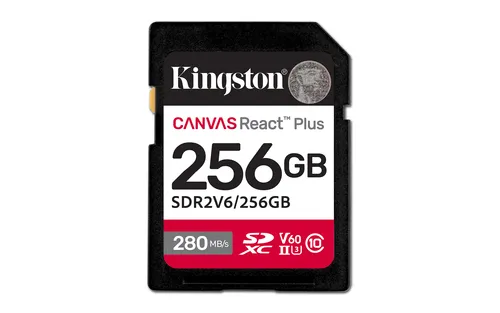
Memory cards Kingston Technology
Kingston Technology 256GB Canvas React Plus SDXC UHS-II 280R/150W U3 V60 for Full HD/4K
Relevance for this use: 72/100
When you photograph sports events, wildlife scenes or family moments in burst mode, your camera records several images per second. This intensive practice demands a card capable of keeping pace without slowing capture or blocking the shutter.
Read speed then becomes the decisive criterion to quickly empty the card and resume shooting, while capacity takes a back seat because you regularly transfer your files. Price remains reasonable compared to your photographic equipment cost, but without wasting on space you do not fully exploit.
This situation favours responsiveness: you seek a card that never makes you wait between two photo series and allows you to immediately view your shots on the camera screen. Read speed guarantees your workflow remains fluid, from capture to computer transfer.
The same criteria as on the category page, but not the same weight: here is what goes up and what goes down.
Read speed becomes a priority when you photograph in burst mode or film in high definition. Market measurements range from one hundred to eight hundred megabytes per second, with a median at one hundred and eighty. To instantly display your latest shots on the camera screen and quickly transfer hundreds of files to your computer after a session, aim for the upper end of this scale. Fast reading spares you waiting frustrations and maintains your photographic productivity. Performance becomes an investment in your daily working comfort, especially when every second counts to capture the next moment.
Price retains some importance because you already invest in expensive photographic equipment. Surveys show an extended price range depending on performance, but no need to overpay for excessive capacity you will never use. Seek the best balance between high read speed and controlled cost, favouring performance over maximum storage space. A high-performance card at reasonable price represents the balanced choice for an active photographer who regularly transfers files and does not accumulate thousands of images on a single card.
Capacity matters less in this situation because you frequently transfer your photos and videos to a computer or external drive. Market benchmarks range from sixty-four gigabytes to one terabyte, with a median at two hundred and fifty-six gigabytes. For regular photographic practice with daily or weekly transfers, even modest capacity amply suffices. Favouring speed over space avoids paying for storage you will empty before filling. Reasonable size meets your actual needs without unnecessarily weighing down your budget.
The features pushed in this category that make no difference in this context.
Capacity of one terabyte or more
Very large capacity cards appeal to itinerant photographers who spend weeks without computer access. If you transfer your files after each photo outing, this enormous capacity remains unexploited and increases price without benefit. You pay for emptiness.
Protection against airport X-rays
This certification reassures reporters who daily pass security checks with their full cards. For an amateur photographer who empties the card before each trip or stores equipment in the hold, this protection remains superfluous and increases cost without real utility.
Lifetime manufacturer warranty
Very extended warranty appeals to those who keep their cards for a decade. If you regularly renew your equipment to follow technological evolution and benefit from ever-higher performance, a few years warranty amply suffices. Extended warranty is paid for without bringing concrete value.
Orders of magnitude, not displayed prices: a price only appears on Kalyneo once it has been collected from a merchant, with its collection date.
Under €15
Under fifteen euros offer limited speeds that slow immediate viewing of your bursts and extend transfers after each intensive photographic outing.
€15 to €50
Between fifteen and fifty euros, you find intermediate performance and decent capacities that balance speed and space for regular photographic practice with frequent transfers.
Over €50
Beyond fifty euros, you access maximum speeds that make viewing on camera and transfer to computer instantaneous, for photographic workflow without waiting.
Ranked by relevance for this specific case, not by their overall score.
Memory cards Kingston Technology
Relevance for this use: 72/100
A product only enters this list if it meets every one of these points. Its relevance is rated for this specific use, independently of its overall score in the category.