Memory cards Kingston Technology
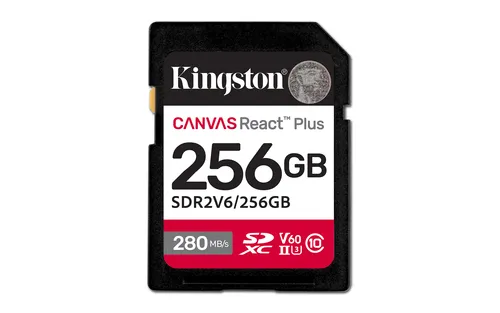
Kingston Technology 256GB Canvas React Plus SDXC UHS-II 280R/150W U3 V60 for Full HD/4K
Relevance for this use: 71/100
When you gather the entire family photo library on a memory card, you centralise several years of memories: holidays, celebrations, portraits, events. This digital archive grows continuously and requires generous space to accommodate thousands of files without constraint.
Capacity then becomes the decisive criterion, followed by read speed to quickly browse your albums and find a specific shot among hundreds. Price takes a back seat to the irreplaceable value of the memories you protect. A card that is too small would force you to multiply media and fragment your collection.
This situation values sustainable investment: you seek a solution that will accommodate your current and future photos, while allowing you to view your memories without waiting. Maximum capacity guarantees you will not run out of space for many years, and fluid read speed makes consulting your photo library as pleasant as leafing through a paper album.
The same criteria as on the category page, but not the same weight: here is what goes up and what goes down.
Capacity becomes a priority because a complete family photo library represents thousands of files accumulated over many years. Market benchmarks range from sixty-four gigabytes to one terabyte, with a median at two hundred and fifty-six gigabytes. To centralise all your photos without having to sort or delete memories, aim for the upper end of this scale. Large capacity spares you fragmentation of your collection across several cards and leaves you margin to enrich your archive for years. Generous space becomes an investment in complete preservation of your family memory, without compromise.
Read speed gains importance when you regularly browse thousands of photos to find a specific memory or prepare a slideshow. Market measurements range from one hundred to eight hundred megabytes per second, with a median at one hundred and eighty. To quickly display hundreds of thumbnails and open high-resolution images without frustrating latency, favour high performance. Fluid reading transforms consulting your photo library into daily pleasure rather than a waiting chore. Speed matters as much as space when you want to relive your memories spontaneously.
Price becomes secondary to the irreplaceable sentimental value of your family memories. Surveys show a wide price range depending on capacities and performance, but to protect thousands of unique photos, saving a few euros on the card exposes your memories to insufficient media. Favour capacity and speed that guarantee complete preservation and pleasant consultation of your photographic heritage. Initial investment spreads over many years of daily use, while losing memories through lack of space or enduring exasperating slowness costs far more in frustration.
The features pushed in this category that make no difference in this context.
Minimum capacity of sixty-four gigabytes
Low-capacity cards suit occasional uses but fragment a complete photo library across several media. This dispersion complicates searching for a specific photo and multiplies risks of loss or forgetting. To centralise your entire family memory, minimal space does not suffice.
Write speed for burst photography
Recording speed serves photographers who capture sports or wildlife sequences in burst mode. For an archive of already-taken photos transferred from various devices, this performance brings you nothing. You consult your photo library, you do not capture continuously.
MicroSD format without adapter
Miniature cards without standard adapter limit compatibility with domestic card readers and computers. For a photo library consulted on different family equipment, standard format or included adapter guarantees universal access without technical constraint.
Orders of magnitude, not displayed prices: a price only appears on Kalyneo once it has been collected from a merchant, with its collection date.
Under €15
Under fifteen euros offer limited capacities that fragment a complete family photo library and slow consultation of thousands of memories across several scattered media.
€15 to €50
Between fifteen and fifty euros, you find intermediate capacities and decent speeds, but to centralise your entire photographic memory, space often remains tight.
Over €50
Beyond fifty euros, you access maximum capacities and high speeds that accommodate thousands of photos and make consulting your memories as fluid as pleasant.
Ranked by relevance for this specific case, not by their overall score.
Memory cards Kingston Technology
Relevance for this use: 71/100
A product only enters this list if it meets every one of these points. Its relevance is rated for this specific use, independently of its overall score in the category.