Laser printers Brother
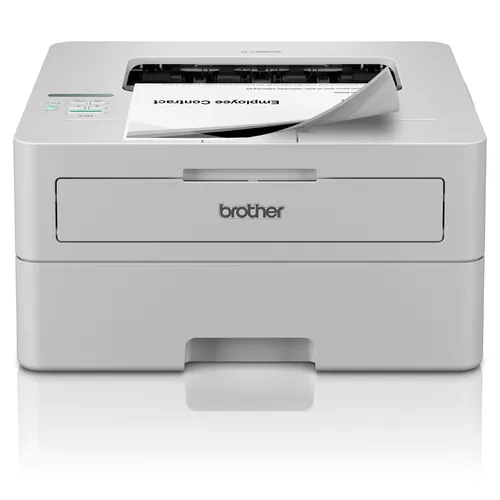
Brother HL-L2865DW laser printer 1200 x 1200 DPI A4 Wi-Fi
Relevance for this use: 67/100
A medical practice prints in short bursts throughout the day: prescriptions between consultations, letters for correspondents, certificates for patients. The printer must start quickly, chain pages without slowing down and hold enough paper to avoid refills during office hours. Responsiveness outweighs energy sobriety.
Each minute gained at startup or output speed frees medical time. Generous capacity avoids interrupting the consultation to refill the tray. Volumes remain moderate compared to a large company, but immediate availability matters more than weekly electrical consumption.
The same criteria as on the category page, but not the same weight: here is what goes up and what goes down.
Purchase price stays watched in a private practice budget but comes after productivity. Saving two minutes daily over a year pays back a reasonable premium. Professional reliable models cost more than entry devices but break down less often under intensive use. A device lasting five years without failure beats a cheap fragile model.
Print speed becomes critical when chaining prescriptions and letters all day. Printing fifty pages per minute instead of twenty halves waiting time at each run. Benchmarks scale from twenty pages per minute for slow models to fifty for the fastest, median at thirty-three across thirty sheets. This difference shows from the third printed page onwards.
A large paper tray avoids refilling mid-consultation. Holding six hundred fifty sheets allows lasting a week without intervention, against two days with one hundred fifty. Benchmarks range from one hundred fifty sheets for compacts to six hundred fifty for professionals, median at two hundred fifty across thirty sheets. Maximum capacity imposes itself in active practice to secure flow.
Electrical consumption weighs little against time saved. A practice prints during continuous daytime, the device stays on twelve hours. The difference between zero point two three and zero point six two kilowatt-hours per week represents a few euros yearly, negligible before staff cost. Benchmarks range from zero point two three for sober to zero point six two for greedy, median zero point three four across thirty sheets.
Time to first page conditions practice fluidity. Waiting four seconds instead of eleven between two patients avoids frustration and maintains rhythm. Benchmarks scale from nearly eleven seconds for the slowest to under four for the most responsive, median around seven seconds across thirty sheets. Quick startup counts as much as sustained speed.
The features pushed in this category that make no difference in this context.
Extended eco mode
Energy-saving modes that prolong warm-up time counter medical use. The practice demands immediate availability between consultations. An extra delay of a few seconds breaks flow and annoys patients and practitioner. Better stable consumption than a long wake that disrupts daily rhythm.
Colour functions
Colour inflates price and slows printing for zero benefit in routine use. Prescriptions, letters and certificates remain monochrome by regulatory obligation. Rare colour documents outsource or print elsewhere. A fast black-and-white laser amply suffices and costs less in consumables.
Ultra-muffled silence
Very quiet models cost more without bringing real comfort in a partitioned practice. The printer stays in a separate room or administrative area, its noise does not reach the consulting room. Paying a sophisticated noise-reduction device cannot be justified when insulation suffices. A standard model fits perfectly.
Multiple configurable trays
Multi-tray systems for different formats appeal to publishing departments, not a medical practice. One prints on a single standard format all day. Multiplying trays complicates the device, raises its price and takes up space. A single large-capacity tray meets real needs better than an unused modular configuration.
Orders of magnitude, not displayed prices: a price only appears on Kalyneo once it has been collected from a merchant, with its collection date.
Under €150
Under one hundred fifty euros give slow and unresponsive printers, suited to home but insufficient for the sustained pace of an active practice.
€150 to €400
From one hundred fifty to four hundred euros, models offer the speed, responsiveness and capacity needed to print continuously without slowing consultation.
Over €400
Beyond four hundred euros, advanced functions target large hospital departments: their price justifies only at very high volume or complex network.
Ranked by relevance for this specific case, not by their overall score.
Laser printers Brother
Relevance for this use: 67/100
Laser printers HP
Relevance for this use: 58/100
A product only enters this list if it meets every one of these points. Its relevance is rated for this specific use, independently of its overall score in the category.