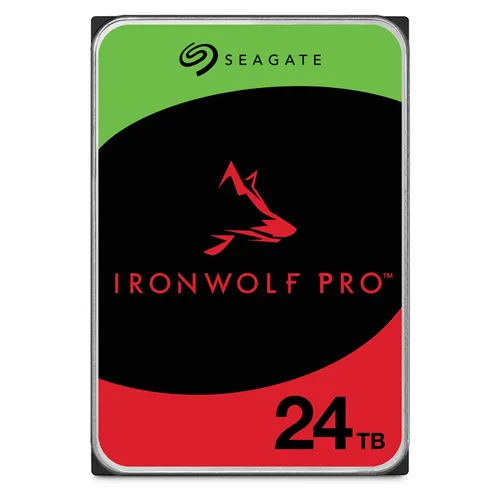
Internal hard drives Seagate
Seagate IronWolf Pro ST24000NT002 internal hard drive 24 TB 7200 RPM 512 MB 3.5" Serial ATA III
Relevance for this use: 62/100
When accessing certain data rarely, archiving old documents or backing up seldom-consulted files, drive speed becomes secondary. The essential is having reliable storage space without straining the budget, as these files often remain untouched for weeks.
In this context, rotation performance and maximum interface throughput lose their importance. One seeks above all the best ratio between price and offered capacity, accepting longer access times since demands remain occasional and patience replaces urgency.
The same criteria as on the category page, but not the same weight: here is what goes up and what goes down.
Price becomes the dominant criterion for occasional use, as every euro saved matters more than performance. We favour affordable models offering sufficient storage without multiplying expenses. Comparing merchant prices helps find the best compromise for rarely consulted files, where speed does not influence daily experience.
Capacity retains its usefulness but moderately, as occasional use does not quickly fill available space. Between three hundred gigabytes and six terabytes, market benchmarks show that average size around one thousand eight hundred gigabytes often suits needs. No point targeting maximum if archived files occupy little space and grow only slowly over months.
Rotation speed loses importance when accesses remain spaced over time. Whether the drive spins at seven thousand two hundred or fifteen thousand revolutions per minute changes little if consulting a file once weekly. Slower models, positioned towards lower benchmarks, suffice largely and reduce costs without practical inconvenience for this usage.
Maximum interface throughput matters little in this scenario, as transferring files occasionally does not justify targeting highest values. Between six and twelve gigabits per second, the difference measures in seconds on rare operations. Favouring standard interfaces, even at lower benchmarks, does not alter comfort of occasional and spaced usage.
The features pushed in this category that make no difference in this context.
Maximum rotation speeds
Paying for drives spinning at fifteen thousand revolutions per minute is unjustified if files remain motionless for days. Fast models consume more and cost more without bringing measurable benefit in a context of rare and spaced consultations.
Very high throughput interfaces
Investing in interfaces reaching twelve gigabits per second or more offers few advantages when transferring files once monthly. More modest standards, around six gigabits per second, suffice amply and reduce overall cost without slowing occasional operations.
Excessive capacities
Buying six terabytes when storing a few hundred gigabytes would mean paying for unused space for years. Better to dimension capacity closest to actual needs, adding a second drive later if the situation evolves.
Orders of magnitude, not displayed prices: a price only appears on Kalyneo once it has been collected from a merchant, with its collection date.
Less than €50
Less than fifty euros offers entry-level models with modest capacities and standard speeds, perfect for archiving light documents without frequent demands.
€50 to €100
Between fifty and one hundred euros, drives balance reasonable capacity and acceptable reliability, suited to occasional storage without compromising file durability.
More than €100
Beyond one hundred euros, one mainly pays for unnecessary performance in this context, except specific need for intermediate capacities with extended warranties or particular certifications.
Ranked by relevance for this specific case, not by their overall score.
Internal hard drives Seagate
Relevance for this use: 62/100
A product only enters this list if it meets every one of these points. Its relevance is rated for this specific use, independently of its overall score in the category.