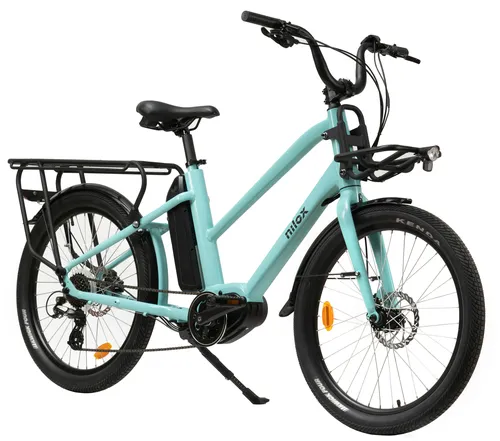
Electric bikes Nilox
Nilox 30NXEBCMMV1 electric bicycle Blue Aluminium 61 cm (24") Lithium
Relevance for this use: 68/100
Daily commutes in the city rarely exceed ten kilometres per day. In this context, maximum range becomes secondary: charging every evening poses no constraint. Purchase price and bike weight matter more for daily use without detours.
A modest motor suffices on flat city centres. Load capacity remains limited to a bag or laptop. What matters most is good value for money for a vehicle used on predictable, short distances, without requiring an oversized battery.
The same criteria as on the category page, but not the same weight: here is what goes up and what goes down.
Price becomes decisive for daily urban use. Investing in excessive range or power increases cost without real benefit. An affordable model, well-built and suited to short trips, offers better value than premium equipment whose capabilities remain unused on routes of a few kilometres.
Range weighs less in the ranking for short urban trips. A capacity of thirty to forty kilometres amply covers several daily round trips. Charging every night requires no particular effort. The highest values, around ninety kilometres, provide unnecessary security for those covering less than ten kilometres daily.
Charging time matters little when the bike remains plugged in all night. Whether the battery requires four, five or six hours matters little if charging occurs during sleep. This criterion therefore does not deserve high weight in the choice, except when charging during the day, which remains rare for regular, predictable urban use.
Motor power has less importance on flat urban routes. A hundred-and-fifty-watt motor amply suffices to assist pedalling on tarmac, without steep hills. Seven-hundred-and-fifty-watt motors target hilly terrain or heavy loads, infrequent situations in town. A median model at two hundred and fifty watts already generously meets needs.
Maximum load capacity remains secondary for light urban use. Carrying a bag, laptop or some shopping rarely exceeds ten to fifteen kilogrammes. Bikes capable of supporting a hundred and fifty kilogrammes target families or deliveries. For daily trips without bulky luggage, a hundred kilogrammes of maximum load offers a comfortable and sufficient margin.
The features pushed in this category that make no difference in this context.
High-capacity battery
A battery offering ninety kilometres of range adds weight, increases price and extends charging time. For daily trips of a few kilometres, this capacity remains unused. A median range of sixty-five kilometres already far exceeds typical urban needs, without extra cost or additional weight.
Very powerful motor
A seven-hundred-and-fifty-watt motor targets mountainous terrain or heavy loads. In town, on the flat, it consumes more energy without providing additional assistance. A model of a hundred and fifty to two hundred and fifty watts amply suffices, reduces cost and preserves range for urban routes without elevation.
Reinforced frame for heavy loads
Frames sized for a hundred and fifty kilogrammes aim at transporting passengers or goods. For light individual use, they add weight without benefit. A frame designed for a hundred kilogrammes already offers a comfortable margin for the cyclist and personal belongings, while ensuring manoeuvrability and lightness.
Orders of magnitude, not displayed prices: a price only appears on Kalyneo once it has been collected from a merchant, with its collection date.
Under €1000
Models under a thousand euros offer performance suited to short urban trips, with sufficient range and an efficient motor on the flat.
€1000 to €2000
Between a thousand and two thousand euros, comfort and finish improve, but gains in range or power remain of little use for limited daily routes.
Over €2000
Above two thousand euros, premium equipment targets more demanding uses and far exceeds the needs of a short urban commute of a few kilometres.
Ranked by relevance for this specific case, not by their overall score.
Electric bikes Nilox
Relevance for this use: 68/100
A product only enters this list if it meets every one of these points. Its relevance is rated for this specific use, independently of its overall score in the category.