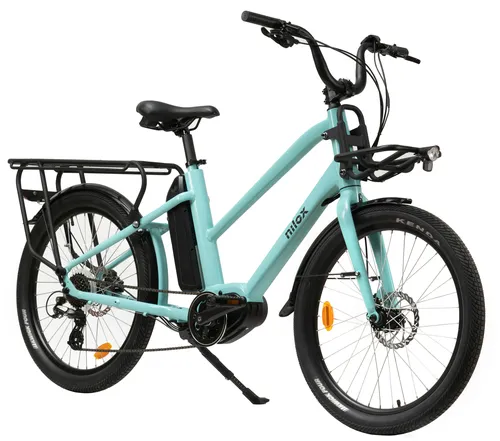
Electric bikes Nilox
Nilox 30NXEBCMMV1 electric bicycle Blue Aluminium 61 cm (24") Lithium
Relevance for this use: 69/100
Transporting bulky shopping, a child or professional equipment demands a bike capable of supporting significant loads without bending. Maximum capacity distinguishes versatile models from utility bikes. A powerful motor becomes essential to start with a hundred kilogrammes of load and climb hills effortlessly.
Price remains important for a purchase often made by families or professionals. Standard range suffices for urban trips with load: distances covered rarely exceed twenty to thirty kilometres daily. Charging time matters less when the bike parks each evening in the same place, near a socket.
The same criteria as on the category page, but not the same weight: here is what goes up and what goes down.
Price retains weight in choosing a utility bike, often bought to replace a car or complement professional equipment. Models capable of carrying a hundred and fifty kilogrammes cost more, but avoid investing in a motorised vehicle. Good value for money provides access to heavy-load capacity without excessive expense, provided robustness takes priority over comfort options.
Range retains its usual weight for load transport. Urban trips with luggage or children remain short, rarely beyond thirty kilometres daily. A median capacity of sixty-five kilometres amply covers these needs. High values provide additional security, but do not justify sacrificing power or load capacity.
Charging time weighs less for regular utility use. The bike remains parked each evening in the same place, allowing complete overnight charging. Whether the battery requires four, five or six hours matters little if the bike departs the next morning. This criterion counts only for those making multiple daily rotations, a rare situation for family or craft use.
Motor power becomes decisive for transporting heavy loads. Starting with a hundred kilogrammes of shopping or equipment requires a motor of at least two hundred and fifty watts. Models reaching seven hundred and fifty watts facilitate uphill starts and maintain stable speed despite weight. A hundred-and-fifty-watt motor struggles quickly and discourages regular use with load.
Maximum load capacity becomes the central criterion for utility transport. A hundred kilogrammes suffices for an adult and light shopping, but becomes tight with a child or professional equipment. Models capable of carrying a hundred and fifty kilogrammes offer comfortable margin and permit transporting two children, large volumes or heavy tools without risking bike structure.
The features pushed in this category that make no difference in this context.
Very short charging time
A battery charging in four hours instead of six represents unnecessary extra cost for predictable daily use. The bike remains plugged in all night, making this speed superfluous. This time counts for professionals making several rounds, but remains marginal for families or craftspeople who charge at day’s end.
Very extended range
A capacity of ninety kilometres far exceeds the needs of urban load transport. Trips with luggage or children remain short, rarely beyond twenty kilometres daily. This range adds battery weight, increases price and reduces available load capacity, without real benefit for daily use.
Light and minimalist frame
A lightened chassis to improve manoeuvrability sacrifices the robustness necessary for heavy transport. Models designed for only a hundred kilogrammes bend under the weight of a child and bulky shopping. This structural economy weakens the bike and limits its utility use, the main purchase motive for this type of equipment.
Orders of magnitude, not displayed prices: a price only appears on Kalyneo once it has been collected from a merchant, with its collection date.
Under €1000
Models under a thousand euros rarely support more than a hundred kilogrammes and have modest motors, limiting transport of heavy loads or children.
€1000 to €2000
Between a thousand and two thousand euros, bikes offer a hundred and fifty kilogrammes of maximum load and two-hundred-and-fifty-watt motors, suited to family and craft needs.
Over €2000
Above two thousand euros, reinforced equipment maximises power and capacity, ideal for intensive professional use with regular and bulky loads.
Ranked by relevance for this specific case, not by their overall score.
Electric bikes Nilox
Relevance for this use: 69/100
A product only enters this list if it meets every one of these points. Its relevance is rated for this specific use, independently of its overall score in the category.