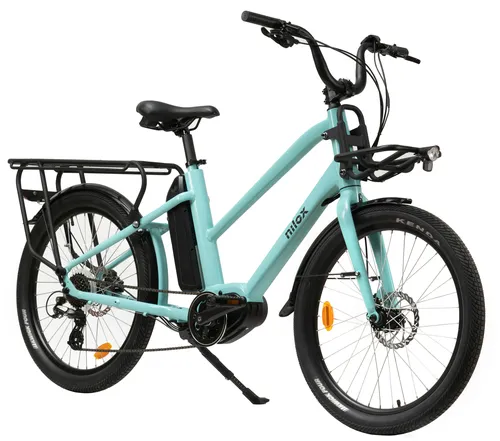
Electric bikes Nilox
Nilox 30NXEBCMMV1 electric bicycle Blue Aluminium 61 cm (24") Lithium
Relevance for this use: 68/100
Outings of several dozen kilometres in the countryside or mountains demand generous range. Covering eighty to a hundred kilometres without fearing breakdown requires selecting models capable of exceeding seventy kilometres of assistance. Fast charging allows departure after a short break, without waiting half a day.
Varied terrain demands a motor powerful enough to climb hills without excessive effort. However, load capacity remains secondary: the cyclist carries essentials, without loading heavy luggage. Price matters, but takes second place to reliability over long distances and the ability to return to the starting point without anxiety.
The same criteria as on the category page, but not the same weight: here is what goes up and what goes down.
Price retains its importance, but yields slightly to range and charging. Investing in a more expensive model justifies itself if the battery offers extended range and charges quickly. For regular outings of several hours, a reasonable extra cost avoids forced stops and difficult returns.
Range becomes the central criterion for long-distance touring. Models approaching ninety kilometres allow ambitious loops without constantly monitoring the gauge. Below sixty-five kilometres, the risk of breakdown increases on extended routes. Low values, around thirty-two kilometres, suit only short trips and do not meet touring needs.
Charging time gains importance for long outings. Being able to recharge in four hours rather than six allows departure after lunch or a visit, without prolonging the break. Over several days, this difference permits two daily stages instead of one. Slow models hinder exploration and constrain trip organisation.
Motor power matters more on hilly terrain. A two-hundred-and-fifty-watt motor assists effectively on moderate climbs. Models reaching seven hundred and fifty watts facilitate steep slopes without exhausting the cyclist. On flat ground, this power remains underused, but in mountains it transforms the experience and widens the range of accessible routes.
Maximum load capacity weighs less in the choice for touring. The cyclist carries belongings in a light bag: clothing, water, provisions. A hundred kilogrammes of capacity amply suffices. Models designed for a hundred and fifty kilogrammes target goods or passenger transport, needs absent from long solo or light tandem outings.
The features pushed in this category that make no difference in this context.
High load capacity
A reinforced frame for a hundred and fifty kilogrammes adds weight without benefit for touring. The cyclist takes only essentials, rarely more than ten kilogrammes. This structural excess weighs unnecessarily and reduces range, without providing additional comfort or safety over long distances.
Low-range model
A bike limited to thirty-two kilometres requires multiple daily recharges on an extended route. This constraint breaks rhythm, forces searching for sockets and considerably lengthens total outing duration. For touring, a battery offering at least sixty-five kilometres avoids these repeated interruptions.
Low-power motor
A hundred-and-fifty-watt motor struggles on sustained climbs. The cyclist must provide significant effort to compensate, which exhausts over time. In mountains or on hilly roads, this limitation turns the outing into physical ordeal and discourages exploring certain routes otherwise accessible with more generous assistance.
Long charging time
A battery requiring six hours to fully recharge immobilises the bike for half a day. On a multi-day circuit, this duration reduces available riding time and forces organising stages around charging points. A four-hour charge offers more flexibility and autonomy in planning.
Orders of magnitude, not displayed prices: a price only appears on Kalyneo once it has been collected from a merchant, with its collection date.
Under €1000
Models under a thousand euros rarely offer the range necessary for long-distance touring and require significant compromises on charging or power.
€1000 to €2000
Between a thousand and two thousand euros, one finds bikes offering sixty-five kilometres of range and acceptable charging times, suited to extended outings without unlimited budget.
Over €2000
Above two thousand euros, premium equipment maximises range and power, ideal for ambitious routes of several dozen kilometres in complete serenity.
Ranked by relevance for this specific case, not by their overall score.
Electric bikes Nilox
Relevance for this use: 68/100
A product only enters this list if it meets every one of these points. Its relevance is rated for this specific use, independently of its overall score in the category.