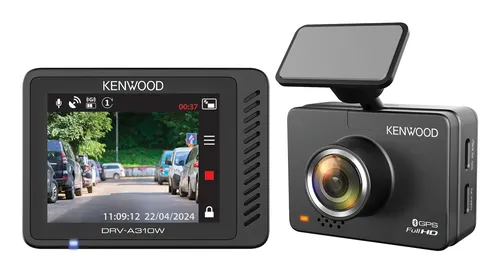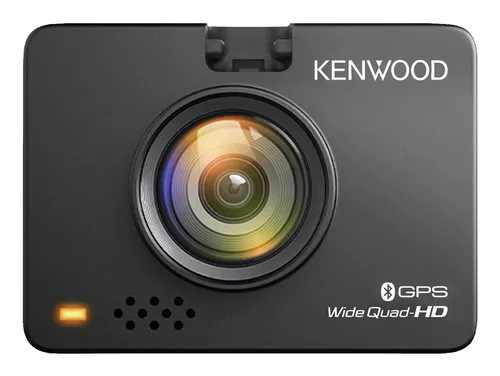
Dash cams Kenwood
Kenwood DRV-A510W dashcam 2K Ultra HD Wi-Fi DC Black
Relevance for this use: 80/100
Drivers making long daily or professional journeys quickly accumulate hours of recording. Trips of several hundred kilometres per day saturate limited memory in a few cycles, forcing frequent file deletion or transfer. This constraint becomes burdensome when the road occupies most of the time.
The choice focuses on storage capacity to limit manual management and price for equipment subject to intensive use. Smoothness keeps its importance but does not require the maximum, and a single front camera suffices when the main objective remains documenting standard road journeys.
The same criteria as on the category page, but not the same weight: here is what goes up and what goes down.
Price gains weight for equipment subject to intensive use and accelerated wear. Long journeys multiply thermal cycles, vibrations and exposure to climatic variations. An affordable model limits financial risk in case of breakdown or early replacement. Investment is justified more by storage capacity than by advanced functions rarely used on motorways. Balanced value for money becomes a priority for recurring professional use.
Recording smoothness retains its standard weight without becoming a priority. Thirty frames per second bring marginal gain on motorways where events unfold at distance and constant speed. Twenty-five frames per second from median models suffice to identify vehicles, signs and trajectories on open roads. Only urban crossings or dense traffic areas would justify maximum smoothness. For mainly motorway journeys, this difference remains secondary.
Storage capacity becomes the dominant criterion for long journeys. Two hundred fifty-six gigabytes from the most generous models allow keeping several days of continuous recording before automatic overwriting. This autonomy avoids daily transfers and guarantees preservation of incidents occurring several days earlier. One hundred twenty-eight gigabytes from entry models force memory clearing after each long journey, a constraint incompatible with intensive professional use. The capacity gap fully justifies moderate extra cost.
The number of cameras loses importance for long motorway journeys. A single front camera covers most situations: collisions, emergency braking, line crossing. Rear incidents remain rarer on fast roads where safety distances increase. Half the market models settle for one camera. Adding a second lens increases price without proportional benefit when eighty per cent of time is spent on open roads.
The features pushed in this category that make no difference in this context.
Extended parking modes
Extended parking surveillance functions consume battery and memory for marginal use. High-mileage drivers spend little time parked and favour autonomy while driving. These modes complicate installation without serving the main use.
Multiple driving alerts
Lane departure, safety distance or driver fatigue warnings prove intrusive and redundant with modern onboard systems. These functions increase price without added value for an experienced driver making repeated journeys.
Premium finishes
Metal casings, large touchscreens or magnetic mounts increase cost for marginal comfort. Sober and robust equipment suffices for daily use where reliability outweighs aesthetics. These refinements are rarely justified in professional context.
Extreme resolution
Maximum definitions inflate file sizes and reduce the number of storable hours at equal capacity. To identify a plate or context on motorways, standard resolution amply suffices. Favour recording duration over maximum definition.
Orders of magnitude, not displayed prices: a price only appears on Kalyneo once it has been collected from a merchant, with its collection date.
Under €50
Models under fifty euros offer limited capacities requiring frequent transfers, constraining for daily long journeys.
€50 to €120
Between fifty and one hundred twenty euros, several models combine extended capacities and controlled prices, ideal balance for intensive professional use.
Over €120
Above one hundred twenty euros, extra costs often fund secondary functions for mainly motorway and repetitive use.
Ranked by relevance for this specific case, not by their overall score.
Dash cams Kenwood
Relevance for this use: 80/100
Dash cams Dahua Technology
Relevance for this use: 52/100
Dash cams Dahua Technology
Relevance for this use: 49/100
A product only enters this list if it meets every one of these points. Its relevance is rated for this specific use, independently of its overall score in the category.