Toasters for occasional use
If you only toast bread on weekends or when hosting occasional guests, there is no need to invest in an oversized appliance. Occasional use prioritises budget control and fine browning adjustments for perfect results even with infrequent operation. Capacity and power take a back seat when the appliance stays stored during weekdays.
This situation reverses usual priorities. Rather than a family-sized four-slot model consuming substantial energy, you benefit from choosing a compact toaster whose numerous browning levels compensate for irregular use. Price becomes decisive, as you do not amortise the purchase through intensive daily operation.
What matters in this specific case
The same criteria as on the category page, but not the same weight: here is what goes up and what goes down.
-
Price
Matters more coefficient 1.8Price weighs nearly twice as much in this situation, as occasional use does not justify a high investment. You use the appliance a few times per month, sometimes less, and profitability is measured over a very long period. Economical models suffice perfectly for toasting a few slices on Sunday mornings. Compare prices found at merchants to find the best value without superfluous features that increase the bill.
-
Capacity
Matters less coefficient 0.6Capacity loses importance when you rarely toast bread. Market benchmarks range from one to four slots, with a median at two slices simultaneously. For occasional use, a single slot may suffice if you live alone, and two slots already meet the needs of a couple hosting guests occasionally. No need to multiply slots for toast prepared in small quantities and without time constraints.
-
Power
Matters less coefficient 0.7Power matters less when toasting time is not a daily priority. Recorded benchmarks range from seven hundred and sixty watts to one thousand six hundred and forty watts, with a median at nine hundred and eighty watts. A moderately powerful model suits infrequent use perfectly, as you are not rushed at weekends. Moreover, moderate power limits electricity consumption over the appliance’s lifespan.
-
Settings
Matters more coefficient 1.3Browning settings gain importance to compensate for irregular use. Between six and eight browning levels according to market benchmarks, with a median at seven, a high number helps you find the right setting even after several weeks without switching on the appliance. Control precision then becomes a comfort criterion, to avoid toast that is too light or burnt when you use the toaster sporadically.
What is not worth paying for
The features pushed in this category that make no difference in this context.
-
Multiple unnecessary slots
Four slots or even three increase price and bulk without real benefit when you rarely toast bread. One or two slices amply suffice for occasional use. You then pay for capacity you never fully utilise, and the appliance unnecessarily occupies space in an already crowded cupboard.
-
Excessive maximum power
Models exceeding twelve hundred watts cost more and consume more for marginal time savings. When you toast bread at weekends without morning urgency, waiting thirty seconds longer does not affect your comfort. Median or slightly lower power perfectly meets the needs of infrequent use.
-
Programmable functions
Electronic timers, setting memories or digital displays increase the bill for useless features when the appliance is rarely used. You easily rediscover your preferences by manually adjusting the browning level at each use. These complex features only make sense in daily kitchen use, not for occasional operation.
Price ranges for this use
Orders of magnitude, not displayed prices: a price only appears on Kalyneo once it has been collected from a merchant, with its collection date.
Under €30
Models under thirty euros offer one or two slots with six to seven browning levels, perfect for occasional use without superfluous investment.
€30 to €60
Between thirty and sixty euros, you find two slots and seven browning levels, a balanced compromise for weekend toasting with precision.
Over €60
Beyond sixty euros, capacities and power increase but exceed the needs of infrequent use, unless you seek premium finish.
The products selected for this use
Ranked by relevance for this specific case, not by their overall score.
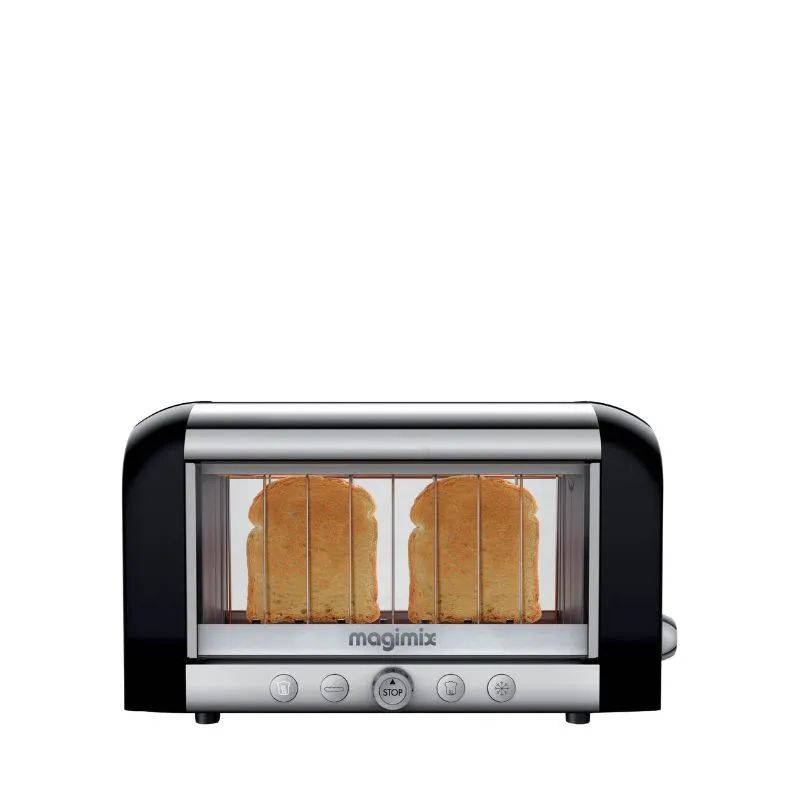
Our selection criteria for this use
A product only enters this list if it meets every one of these points. Its relevance is rated for this specific use, independently of its overall score in the category.
- Selected products feature one or two slots to limit bulk and cost.
- They provide at least six browning levels to finely adjust browning despite irregular use.
- Their power remains at or below one thousand watts to control electricity consumption.
- They display a contained price, suited to an appliance used only a few times per month.
Other situations in this category
Toasters for large families
Compare toasters for large families. Find a high-capacity, powerful model to toast multiple slices quickly every morning.
Read
Toasters for artisan bread enthusiasts
Compare toasters for artisan bread. Find a model with precise settings and good power for thick, irregular slices.
Read