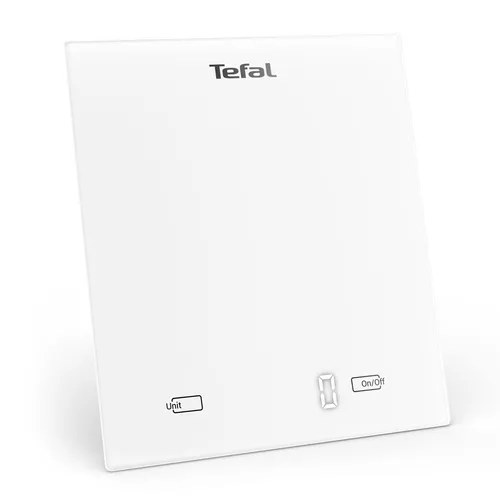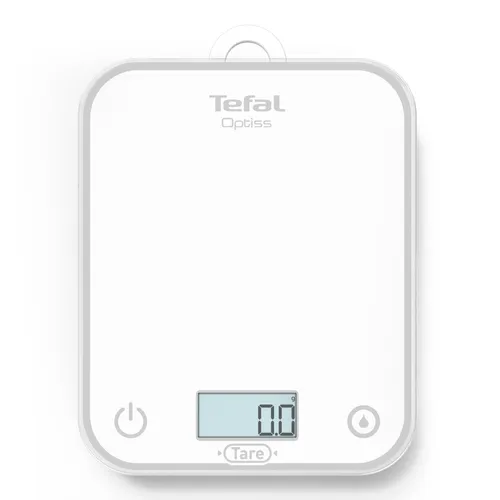
Kitchen scales Tefal
Tefal Optiss BC50U0 White Countertop Rectangle Electronic kitchen scale
Relevance for this use: 80/100
Succeeding with a meringue, macaron or sponge cake requires respecting proportions to the nearest gram. Even a minimal margin of error disrupts the balance between flour, sugar and fats, compromising the final texture. Baking recipes tolerate no approximation.
Graduation precision becomes the central criterion, well ahead of maximum capacity. A model capable of measuring to the nearest half gram guarantees dosage accuracy, whereas one-gram graduation introduces cumulative gaps. Compactness also counts: on a cluttered worktop, a thin scale slips in easily.
This ranking highlights scales offering the best measurement fineness while remaining unobtrusive. Maximum capacity takes a back seat, since baking weighing operations rarely exceed a few hundred grams per ingredient.
The same criteria as on the category page, but not the same weight: here is what goes up and what goes down.
Budget retains its usual weight to avoid over-investing in kitchen equipment. Highly precise models do not necessarily cost more than mainstream scales. Comparing prices helps find a fine scale without paying for superfluous functions. The price range observed among merchants guides the choice towards the best balance between precision and expenditure.
Graduation fineness becomes paramount for weighing delicate ingredients with exactness. On the market, recorded datasheets show a median precision of one gram, with a best reading at half a gram. In baking, half-gram graduation allows respecting demanding recipes. Descending to this fineness eliminates approximations and guarantees success with preparations sensitive to dosage variations.
Maximum capacity loses importance when rarely weighing more than five hundred grams per ingredient. Market datasheets show a median maximum weight of five kilograms, the best reaching ten kilograms and the lowest three kilograms. For baking, a scale at three or five kilograms suffices amply. Favouring excessive capacity brings nothing and may harm precision.
Compactness gains importance on a worktop where every centimetre counts. Recorded datasheets indicate a median height around twenty-two millimetres, with a best reading at fifteen millimetres and a lowest at one hundred fifty millimetres. A very flat scale, close to fifteen millimetres, stores easily and frees space. Compactness also facilitates storage in a drawer.
The features pushed in this category that make no difference in this context.
Ten-kilogram capacity
A scale capable of weighing up to ten kilograms serves no purpose in baking, where ingredients are dosed in small quantities. This excessive capacity often inflates price and bulk. A model at three or five kilograms suffices broadly.
Extra-large platform
A very large platform uselessly occupies the worktop and complicates storage. In baking, one weighs bowls or measuring cups of modest size. A compact platform accommodates these containers without wasting space.
Continuous weighing function
Certain models propose weighing ingredients added successively without resetting to zero. This function complicates use and does not replace graduated precision. Weighing each ingredient separately remains more reliable for respecting dosages.
Backlit display
A screen with permanent backlighting consumes energy and inflates the price without bringing practical gain in a well-lit kitchen. A simple, contrasted display reads perfectly in natural light.
Orders of magnitude, not displayed prices: a price only appears on Kalyneo once it has been collected from a merchant, with its collection date.
Less than €15
Less than fifteen euros provide access to correct scales with precision often limited to one gram, sufficient for simple baking.
€15 to €40
Between fifteen and forty euros, models regularly reach half-gram precision, with increased compactness and better reliability for demanding recipes.
More than €40
Beyond forty euros, scales sometimes offer superfluous functions without significantly improving graduation fineness for domestic baking.
Ranked by relevance for this specific case, not by their overall score.
Kitchen scales Tefal
Relevance for this use: 80/100
Kitchen scales Tefal
Relevance for this use: 77/100
A product only enters this list if it meets every one of these points. Its relevance is rated for this specific use, independently of its overall score in the category.