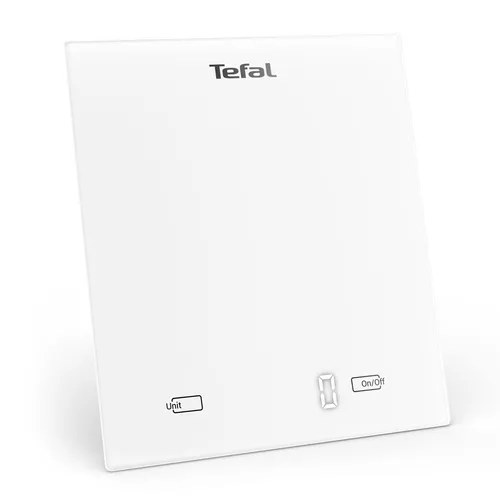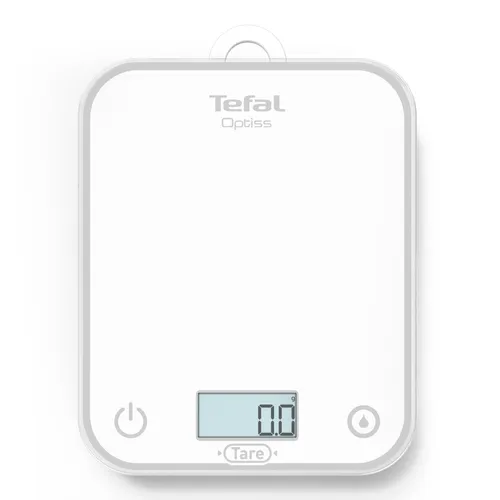
Kitchen scales Tefal
Tefal Optiss BC50U0 White Countertop Rectangle Electronic kitchen scale
Relevance for this use: 74/100
Preparing preserves, cooking for gatherings or batch cooking requires weighing filled containers, whole poultry or several kilograms of ingredients at once. A scale limited to three or five kilograms forces you to divide weighing operations, leading to errors and wasted time.
Maximum capacity becomes the decisive criterion, well ahead of graduation fineness. A model reaching ten kilograms accommodates a filled pot or a bowl of dough without compromising accuracy. Price and compactness take a back seat to this versatility.
This ranking highlights scales that support the heaviest loads while remaining financially accessible. Precision to the nearest gram retains its usefulness, but a slightly wider graduation does not hinder weighing substantial volumes.
The same criteria as on the category page, but not the same weight: here is what goes up and what goes down.
Budget remains a reinforced priority to avoid disproportionate investment in preparation equipment. High-capacity models sometimes cost more, but the market offers affordable solutions. Comparing prices helps find a robust scale without overpaying for superfluous functions. The price range observed among merchants guides the choice towards the best balance between capacity and expenditure.
Graduation fineness loses importance when weighing several kilograms of ingredients. On the market, recorded datasheets show a median precision of one gram, with a best reading at half a gram. For large volumes, one-gram graduation proves entirely sufficient. Descending to half a gram brings little practical advantage and does not justify extra cost or increased bulk.
Maximum capacity becomes the central criterion for weighing without constraint. Market datasheets show a median maximum weight of five kilograms, the best reaching ten kilograms and the lowest three kilograms. A ten-kilogram scale allows weighing a pot, a large bowl or a whole poultry without dividing operations. Favouring this elevated capacity avoids repeated handling and cumulative errors.
Compactness matters less when seeking primarily load capacity. Recorded datasheets indicate a median height around twenty-two millimetres, with a best reading at fifteen millimetres and a lowest at one hundred fifty millimetres. A slightly taller scale remains acceptable if it supports heavy loads. Compactness must not take precedence over platform robustness nor maximum capacity.
The features pushed in this category that make no difference in this context.
Precision to the tenth of a gram
Ultra-fine graduation brings nothing when weighing kilograms of vegetables or meat. It belongs to precision baking, not volume cooking. A model accurate to one gram suffices amply and costs less.
Ultra-flat design
Seeking minimal thickness often limits platform solidity and load capacity. A slightly thicker scale offers better stability under heavy containers. Very thin aesthetics do not justify sacrificing robustness.
Complex conversion functions
Multiple conversion modes between exotic units inflate the price without serving domestic cooking. Weighing in kilograms and grams remains the standard. Automatic conversions to other systems do not facilitate preparing large quantities.
Orders of magnitude, not displayed prices: a price only appears on Kalyneo once it has been collected from a merchant, with its collection date.
Less than €15
Less than fifteen euros provide access to basic models with capacity often limited to three or five kilograms, sufficient for occasional use.
€15 to €40
Between fifteen and forty euros, scales regularly reach five to seven kilograms, with a more stable platform and better longevity for frequent preparations.
More than €40
Beyond forty euros, models rise to ten kilograms, offering robustness and versatility for batch cooking without compromise.
Ranked by relevance for this specific case, not by their overall score.
Kitchen scales Tefal
Relevance for this use: 74/100
Kitchen scales Tefal
Relevance for this use: 74/100
A product only enters this list if it meets every one of these points. Its relevance is rated for this specific use, independently of its overall score in the category.